Mette, who looks after our social media and marketing, put five questions to Jess, our in-house marine biologist and one of our dive instructors, and her answers are below, lightly edited for grammar. Jess talks our guests through whale sharks and manta rays, and her bio sits with everyone else’s on our team page.
Please introduce yourself

Jess: My name is Jess, and I am originally from South Africa. I grew up around the beach, which gave me an amazing interest in what is happening beneath the waves. My family and I actually immigrated from South Africa to the UK, and I decided to study, but I wasn’t sure what I wanted to focus on. I started studying general animal behaviour. And then, for my dissertation, I went to Mexico and I studied the effect of tourism on green sea turtles. While there, I met a PhD student who was studying blue carbon, which is the gaseous exchange within our coral reefs and that kind of boosted my interest in coral in general. So I’ve been travelling around a lot, trying to get involved in different coral projects and obviously trying to dive in areas where coral reefs are still healthy and where I can still help.
What brought you to the Maldives, and what projects have you been involved in while working in the Maldives?
Jess: I was actually very lucky to get a job position in the north of the Maldives, in Shaviyani Atoll, in a marine biologist role working on coral restoration. I worked in the north for about 2 years, and I had my own coral restoration project, where I was using metal frames to collect coral fragments and create an environment for those fragments to be able to thrive. After that, we would then move the frames back onto the reef to promote healthy coral tissue on the reef itself. While I was there as well, I was able to transplant some fragments directly onto the reef, which also promotes healthy coral growth. But from what I heard, the coral health up in the north of the Maldives is struggling because of the temperatures.
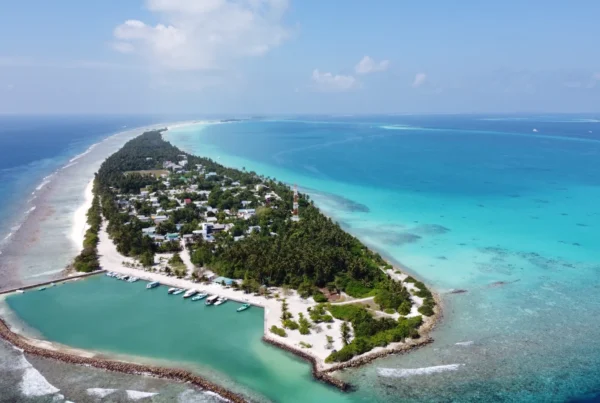
When I was working there, the temperatures got up to about 32 degrees in the water, 30 degrees at 30 metres, so the coral was really struggling. After I left there, I decided to come to a different part of the Maldives, which is where I am now, based in South Ari Atoll with Boutique Beach. What I’ve realised is corals thrive where there are stronger currents, which bring colder water in. That makes them less likely to bleach, because the currents bring in colder water, which means the temperatures don’t stay too high for longer periods of time. I’ve been very lucky to be diving in this area, because the health of the reefs around here is incredible compared to where I was diving before.
How was it to move to South Ari Atoll, and why is this place so amazing to dive, and why is it so fantastic to be the marine biologist here?
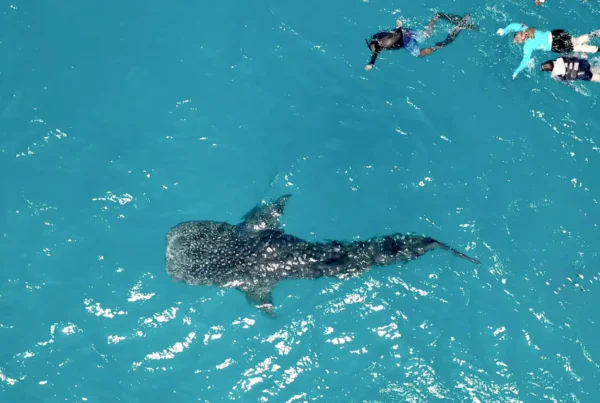
Jess: Being the marine biologist here gives me a lot of opportunities to observe animals that I’ve never been able to observe in the Maldives before. The whale shark is obviously one of the big ones in this area. Knowing that they are here year-round is very interesting to me. Also, the fact that it is a developmental habitat makes it a super important place to be able to dive and be able to actually stay for a while, so I can observe different whale shark behaviours. Obviously, my passion is coral. And having such a variety of dive sites here, all the thilas, giris and Beyru, the outer reef, as well, just gives me a very good insight as to how corals develop and how they grow in different environments and at different depths specifically.
Being the in-house marine biologist at Boutique Beach, what presentations is it that you are giving to the guests?
Jess: I am lucky enough to be able to tell our guests about the whale sharks and manta rays when I do my presentations. It is general information about the whale shark or manta rays and how we should behave when we’re in the water with them. I’ve also created a new coral presentation. I think a lot of people overlook coral. It is one of the most important animals that we have on the reefs. And if we didn’t have coral, we wouldn’t have any of the amazing creatures that we can see while you’re here. So, I have created a coral presentation, just general information about the corals, how to distinguish living coral from dead coral and from rock as well. Many people mistake living coral for a rock and will put their hands on it. And this is very detrimental to the coral. Also, talking to our guests about what’s happening around the world with new coral research and, again, how we should behave when we’re in the water with it.
If you could work on any coral project anywhere in the world, which one would it be and where is it?
Jess: When I was based in Mexico, I was lucky enough to be involved with a lot of coral spawning research. In Playa del Carmen, there are a few universities that are working on coral reproduction, and they go out whenever the coral spawn, which is whenever the corals reproduce. They will release eggs and sperm, which then fertilise and settle on the reef, which create baby corals. But a lot of the time, because of environmental changes, the mature coral colonies are now too far apart from one another. So, whenever the corals release their eggs, oftentimes they’re eaten by fish or swept away before they’re fertilised. Therefore, what the scientists will do, they’ll go out and they’ll collect all the coral eggs and they’ll fertilise them in a lab, where they grow the coral and then transplant those corals back onto the reef. Getting involved in something like that would be absolutely amazing. But also, a big dream of mine is to be able to do that in different places.
Here in South Ari, I have noticed there are tons of mature coral colonies, which means there has to be coral spawning happening at some point throughout the year. Through the research I’ve done in our surrounding areas, there’s not a lot of people that are actually looking at that. I would love to be able to start some kind of coral-spawning watch, to see where the corals are spawning as well as if they actually settle on the reef.