Sondra and Peter emailed us the week after they got home. They had finished their first week on Dhigurah in November 2025, and they were already asking about the next one. They came back in July 2026.
On that first trip they also spent time at a resort. On the second they skipped it and came straight to us. So they have now done both versions of the Maldives. We have only ever seen our end of it. If you are weighing up diving the Maldives from Australia, they are better placed than we are to tell you what you would actually be choosing between.
What diving the Maldives from Australia actually costs you in hours
You have probably seen direct flights to the Maldives advertised out of Australia. You cannot book a seat on one. Those seats are sold as packages through appointed agents with the agents’ own accommodation attached, so a diver picking their own hotel would have to travel through Asia.
There are two sensible ways in. Singapore Airlines flies Changi to Malé nonstop, and the outbound leg is comfortably under five hours, so a morning departure from Changi puts you here on the same calendar day. The other is via Colombo. Sri Lankan Airlines flies there from Sydney and Melbourne, and it flies the Colombo to Malé leg as well. Jetstar goes as far as Colombo out of Melbourne, so you book the hop to Malé separately. If Changi is your connection, there is more on flying to the Maldives from Singapore.
Sondra and Peter flew Brisbane to Singapore in about seven and a half hours, sat out a three-hour connection, then flew about four hours on to Malé. Economy, both times. ‘It’s very doable for people that are healthy and fit to travel economy,’ Sondra told us. The leg they still talk about is the one going the other way.
We were with you one day and then we were home the next.
Peter
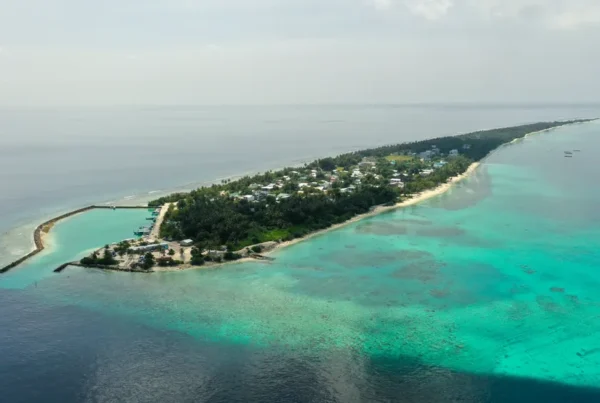
Dhigurah sits 96.8 km south-west of Malé, and that last stretch is a speedboat, a domestic flight to Maamigili, or a seaplane. We organise it once you have booked, but we need your full flight details at least four days out to hold the seats. How the transfers from Malé to Dhigurah work sits on its own page.
Colombo to Malé is about ninety minutes
Colombo to Malé takes an hour and a quarter to an hour and a half – the length of a domestic hop. Several flights go each day, so lock in the long-haul first and slot this one in behind it. The Maldives is a long way from Australia and we’re not going to pretend otherwise. What changes the arithmetic is Sri Lanka.
Plenty of Australians already have Sri Lanka on the list for tea country and the south coast, and the Maldives sits ninety minutes off the end of that trip. Sondra and Peter came in through Sri Lanka the first time and through Singapore the second, so between them the two connections have been tested twice and neither one gave them any grief.
The island where 761 people live
Until 2012 you could only stay on a resort island. That year the Maldivian government allowed guesthouses on inhabited local islands, and that one policy change is the reason a trip like this exists at all.
Dhigurah is one of those islands. About 761 people live here. There is a school with 100 children attending, and a medical centre with a doctor on site, and the name means ‘long island’ in Dhivehi – which the three-kilometre beach earns. Island life on Dhigurah goes on around you.
Peter used a word we didn’t expect. It came back twice. ‘That’s luxury.’ ‘To us, it’s luxury.’ He meant the pace: ‘It’s laid back, easy going, quiet, no noise. It’s just serene.’
There’s one thing to plan around. Local-island regulations mean no alcohol is served on Dhigurah. A resort about ten minutes away does serve it and we can organise a day trip at extra charge, but if someone in your party is coming for the bar and the spa, book a resort island.
We would rather lose the booking than have you work that out on your second night. Peter was relaxed about it: ‘certainly when we’re diving, it’s fantastic not to drink.’
Small groups, and a plan that moves
We have thirteen rooms and six PADI instructors, and we cap dive groups at four or five divers to an instructor. We are a dive hotel designed and managed by divers, for divers, and that ratio is the part of it that costs us money.
The boat is ours. Manta Mobula, our dive boat, is 55 feet and was built here on Dhigurah. When we have more people in we take a second boat, and we put divers in the water in intervals, so nobody is sitting in full kit on a hot deck waiting for the group in front to sort out a torch. Sondra and Peter noticed. Neither visit felt crowded to them, and they have dived places where you are shoulder to shoulder trying to get a tank on.
Certified divers get two or three dives a day, and the plan moves when the conditions move. On their first trip we told them we were not confident about the mantas that week. Then it changed, and we went. ‘You guys were sceptical about seeing the manta rays,’ Sondra said, ‘and then the plans were changed and we went and saw the manta rays.’
Nobody can promise you a manta. We move the boat when the animals move, and that week it worked.
The brief at the end of the day
Both of them served in the Australian Army, one for thirty years and one for forty. That turned out to matter more than we would have guessed, because the first thing they raised about the dive week was the timings.
Every evening the dive team meets everyone at the hotel. We brief the next day, one of our marine biologists gives a short presentation, we all watch the day’s dive video together, and then the evening rolls into dinner on the roof. Jacob gave the presentations in November. Jess gave them in July. Both are marine biologists as well as instructors, and Peter raised the talks without being asked. ‘I really like those talks.’
‘I like the brief at the end of each day. I like the plan for the next morning,’ Sondra said. Then the qualifier: ‘But that structure also comes with a level of flexibility.’ Two people who spent seventy years between them being told where to be at what time noticed both halves of that, which is a compliment we will take.
Our chefs cook to the dive plan, and to whoever is at the table
Shanthi and Amith have both been with us since 2019, and they cook every meal around the dive schedule, so breakfast goes out forty-five minutes before the boat leaves, with roshi and mashuni on it – the Maldivian breakfast – alongside the European options. The fish comes off the Dhigurah boats.
Sondra is vegan. At the resort, she told us, she ate broccoli and salad for a week and came home lighter than she went. ‘They said that they could cater for me. And they could cater for me, but effectively I ate broccoli and salad for a week.’
Peter’s word for the comparison was ‘chalk and cheese’. Two chefs cooking for thirteen rooms can take a request personally.
Everything Shanthi and Amith cook is in the rate, along with the room, the soft drinks and the fresh juices, and two or three dives a day with the guide, the boat, tanks and weights. Nitrox is available on site at 32 per cent. Some things sit outside the rate. You hire equipment if you need it, you pay for a PADI course if you take one, you pay for the airport transfer, and the Maldivian government charges a green tax. Read what the all-inclusive diving package covers before you book, and ask us about anything it does not answer.
Low season is when the animals come closer
Their second trip was in July, in our low season, and they think it was the better week of the two. ‘Your off season is off tap,’ Peter said. Sondra agreed. ‘I’d say the off-season is the time to be there.’
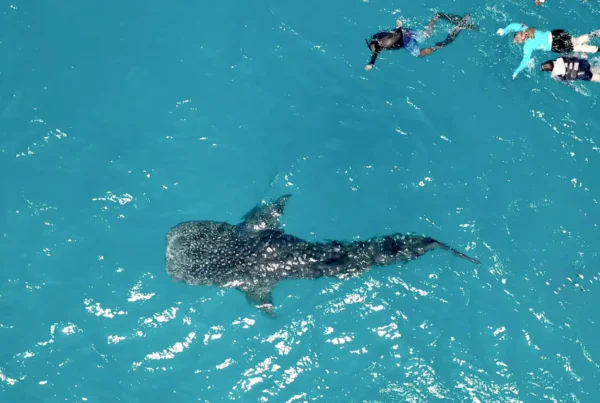
There is a reason for that. The water here stays between 28 and 30 degrees all year, and what changes between the monsoons is the wind direction, not the temperature. From May to November, in the southwest monsoon, the whale sharks range between Dhigurah and Maamigili, so the boat runs shorter trips and more of the diving sits close to home. From December to April they are mostly over on the western side of the atoll and the trips run full-day.
Low season is the season everything comes to us. Mantas are here all year. July and August are a strong window for the big animals, and that is the window Sondra and Peter walked into. South Ari Atoll is the only Maldives atoll with year-round access to both whale sharks and mantas. Our whale shark diving runs all twelve months.
Rain won’t stop you diving. ‘Rain doesn’t really stop you doing anything you want to do as far as scuba diving goes,’ Sondra answered. ‘Wind and storms might.’ It rained on most days of their first trip and they booked again anyway.
Our room rates are lower in the low season as well.
Sondra and Peter say they are coming back next year, and we have told them there will be room. Peter is getting a tattoo of the three animals and was quick to tell us it won’t have our name on it.
Their advice to other Australians was seven days minimum, five at a push, and we would give the same number, because the second week is when you start noticing what you swam past in the first. Peter put it more bluntly than we would:
I would tell Aussies, get your bloody ass out there.
Peter
Other repeater guests Otto and Ingrid came for their tenth stay in September 2026, so it is not only these two.
If you are working out the route, start with a Singapore or Colombo connection, then read how the last leg from Malé works. When you are ready, check dates and book. Once you have booked, send us your full flight details at least four days out so we can hold your transfer seats.